Portal Receipt
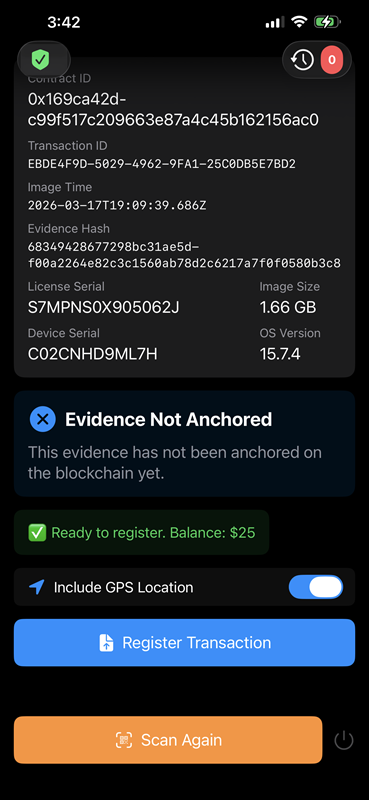
The "Server-side ingestion timestamp" serves as the critical third pillar in our multivariate verification chain, acting as an independent "neutral observer" between the field acquisition and the final blockchain anchor. While the local imaging Mac and the mobile companion app provide the initial data points, the LLSmartVerify portal provides a centralized, server-synced record of exactly when the evidence metadata entered the enterprise ecosystem. This ingestion mark is generated by a secure, high-precision server clock that is synchronized with global NTP (Network Time Protocol) standards, ensuring that the portal’s record is immune to any local clock manipulation or time-zone errors occurring at the physical site of collection.
By capturing the timestamp at the moment of ingestion, the portal effectively "bounds" the window of creation. In forensic terms, this provides a definitive "no later than" date for the evidence. When a field technician completes a scan and the metadata hits our servers, that ingestion time is immediately logged and hard-linked to the transaction. This creates a redundant layer of chronological proof: the time recorded by the Mac, the time synced by the mobile carrier, and the time verified by the portal must all align. If a technician were to attempt to backdate an acquisition on a local machine, the server-side ingestion timestamp would immediately reveal the discrepancy, providing an automated "integrity check" that legacy forensic tools simply cannot offer.
Furthermore, this ingestion point serves as the orchestration trigger for the entire legal workflow. The moment the portal records the timestamped receipt of the metadata, it initiates the smart contract anchoring process and creates the entries necessary for litigation holds and administrative reporting. This ensures that the administrative chain of custody begins the millisecond the evidence is "seen" by the enterprise system. For e-discovery directors and lead investigators, this provides real-time visibility into global field operations, allowing them to track the pulse of a collection effort with the confidence that every entry is backed by a server-validated chronological mark.
In a courtroom setting, the server-side ingestion timestamp acts as the vital bridge that connects a physical collection event to a digital ledger. While a blockchain anchor proves that a file existed at a certain time, the portal’s ingestion log provides the "administrative story" of how it got there. It documents the handover from the field tech’s mobile device to the central repository, providing a clean, audited transition that satisfies the most rigorous requirements for a sound foundational chain of custody. By presenting a timeline that is validated by a secure server environment, you provide the court with a level of forensic certainty that transcends the "single-source" concerns of traditional E01 or AFF4 imaging.